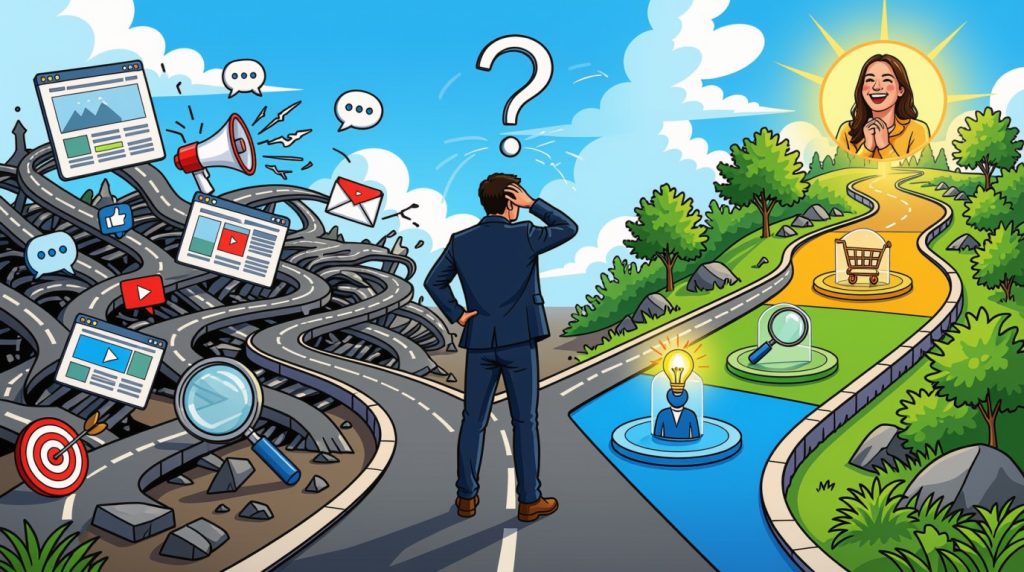
It’s usually not your website, ads, or SEO.
Did you know…
According to studies and surveys, 70 – 90% of marketing campaigns fail to produce the results people hope for.
By “fail to produce the results people hoped for”, I mean one of the following:
- The business did not produce results and lost money.
- The business barely broke even or hardly produced any meaningful results.
- The business didn’t achieve their goal and generate the results they were expecting.
So…
Why is it that most marketing campaigns produce disappointing results?
There can be a lot of reasons…
But more often than not it comes down to this one thing:
not building your marketing around a solid foundation.
This is especially true if you’re doing marketing consistently and still not seeing results.
If you want your marketing to truly work and stop losing money on ads, tools, marketers, etc.
Or, if you want to make sure your marketing is built the right way from the start…
Then make sure you’re building the right foundation first.
It’s the key to marketing success.
The Fundamentals of Marketing
Look at everything around you that’s complex, whether it’s built by nature or man.
Trees.
Buildings.
Boats.
Cars.
Planes.
Or life itself.
All of these things have a foundation that’s built around timeless principles that never change.
Even though these things can grow and improve, they can’t do it without first having a solid foundation in place.
For example, think about a tree.
A tree can’t keep growing without strong roots.
Or take a building.
You can’t build a taller building without a strong foundation.
You can water a tree as much as you want.
You can use the latest tools and technology to keep building taller and taller.
But without strong roots or a solid foundation, it won’t work.
Sooner or later, the tree or building will become unstable and fail.
The same idea applies to marketing.
We’re living in a time where there’s always something new around the corner…
A new tool, a new trend, a new platform you need to show up on…
Then you’re told that if you don’t keep up, you’ll be left behind.
For example, right now, AI is all the rage.
“If you’re not using AI in your marketing, you’re gonna fall behind!”
You’ve probably heard some version of that by now.
Now, don’t get me wrong.
I do believe you should keep up with new trends, tools, and whatever is needed to make sure you stay competitive and succeed in the current times.
For example, right now I encourage all businesses to start automating as much stuff as they can so they save time, create more opportunities, all without having to lift a finger.
But…
Current trends, new technologies, and tools don’t replace the fundamentals.
In fact, if you don’t build a proper foundation, all the new trends, tools, and technologies either won’t work for you or won’t work nearly as well.
Why?
Because your marketing is only as strong as its foundation.
Tools change.
Trends change.
Technology changes.
But the fundamentals of good marketing always stay the same.
If you want your marketing to work not just today, but tomorrow, and the next several years, you need a solid foundation.
The Fundamentals Of Marketing
So, what are the fundamentals of marketing?
The fundamentals of marketing are based on buyer psychology.
Or, more simply how people buy.
Every person, including you and me, follows a similar path whenever we buy something.
After all, we’re all human.
And because of that, we tend to follow a similar psychological process before making a buying decision.
Marketers call this the buyer’s journey.
Whether you’re buying something inexpensive or making a major purchase, you still go through the same core steps.
The only real difference is how quickly you move through them.
Something expensive like buying a home or planning a vacation with their partner will take a lot longer than say something like buying dog food.
A person buying a home may take months or even years before making a decision.
A person planning a vacation may take several hours, days, or even weeks.
And a person buying dog food may only take a few minutes or hours, especially if they really love their dog. 🐶
But no matter how long it takes, they all follow the same logical buying path.
So, what does that path look like?
In most cases, it goes something like this:
- They realize they have a problem or want something.
- They look for a solution.
- They research their options.
- They compare different businesses.
- They decide who they trust the most.
- They weigh the risks and decide if it’s worth the price.
- Then they make a decision.
Again, the steps you see above are the same for buying something expensive 🫰 like a home or vacation vs buying something cheap like dog food or a can of beans.
And this can be said for almost everything you buy.
Whether it’s searching for a dentist, a restaurant, or a barber.
Whether it’s buying a car, remodeling your home, or getting consultation services.
Or even just buying a can of beans.
The steps are all the same.
Again, the only difference is how fast someone goes through them.
Why a lot of Marketing Fails
The mistake a lot of businesses make is trying to skip steps in the buying journey or ignoring certain steps altogether.
For example, many businesses create ads that basically scream:
“Buy now!”
Or…
“Give me your contact information!”
But if someone is still researching and comparing their options, they’re probably not ready for that.
And even if they do click, there’s a good chance they’ll leave without taking the next step.
People in the research phase are looking for information that helps them make a better decision, not a hard sales pitch.
The same thing happens later in the buying journey.
A person may be completely ready to buy, but if you don’t provide enough proof, trust, or reassurance, they may never pull the trigger.
Instead, they’ll leave and choose someone else.
Another common mistake is showing the right information at the wrong time.
For example, someone who’s ready to buy doesn’t need another long explanation of your company.
They need clear benefits, proof, and an obvious next step.
But if you overwhelm them with unnecessary information, you create confusion, frustration, or hesitation.
And hesitation is often enough to lose the sale.
Observe Yourself
One of the best ways to understand your customers is to pay attention to how you buy.
Think about the last time you bought a book, hired a contractor, booked a vacation, bought a car, picked a restaurant, or even grabbed a bag of rice at the grocery store.
Even though those purchases are completely different, you still went through a very similar mental process.
You asked yourself questions.
You compared your options.
You looked for reasons to trust one choice over another.
The only real difference was how long you spent doing it.
For something inexpensive, like shampoo or a bag of rice, that process might take a few seconds.
You might compare a few brands, read the label, notice something like “100% organic” or “all natural,” and make a decision.
For something expensive, like a car, vacation, or home remodeling project, you spend much longer.
You search Google.
Visit different websites.
Read reviews.
Compare businesses.
Watch videos.
Look through social media.
Maybe even ask friends or browse online forums.
That’s exactly what your customers are doing too.
The more aware you become of your own buying process, the easier it becomes to understand theirs.
Going Deeper
Every step of the buyer’s journey comes with its own set of questions.
This is where every product or service starts to become different.
The overall journey is the same.
But the conversations happening inside a person’s head are not.
Someone buying hiking boots will ask completely different questions than someone hiring a contractor or choosing a dentist.
If you want your marketing to be truly effective, your job is to figure out those questions as accurately as possible.
Here’s a simple example of what that conversation might look like for someone shopping for a pair of hiking boots.
Initial stage
At first, you’re just trying to figure out what you need.
- I’m going hiking with my friends. What kind of hiking boots should I buy?
- Do I even need hiking boots, or will regular shoes work?
- What’s the difference between hiking shoes and hiking boots?
- What should I look for before buying a pair?
- How much should I expect to spend?
Research stage
Now you’ve narrowed it down and are evaluating specific options.
- Are these boots comfortable for long hikes?
- Are they waterproof or just water resistant?
- Will they last for years or wear out quickly?
- Are they good for the type of hiking I’ll be doing?
- Do they need to be broken in?
- How’s the traction on wet rocks or muddy trails?
- What do people who actually own them say?
- What’s covered under the warranty?
- If something goes wrong, will the company actually help me?
Comparison stage
Now you’re deciding between a few finalists.
- Which brand is more comfortable?
- Which one lasts longer?
- Which one has better reviews?
- Which company has better customer service?
- Which one gives me the best value for the money?
- Is this pair really worth paying more for?
Decision stage
Right before buying, you’re looking for reasons not to buy.
- What are the worst reviews saying?
- Is there a common problem people keep mentioning?
- Can I return them if they don’t fit?
- Do I trust this company enough to spend my money with them?
- Am I missing a better option?
- Alright… I think these are the ones.
- Buy now.
As you can see, that’s the kind of conversation that typically happens in someone’s head when they’re buying a pair of hiking boots.
Every product and every service has a conversation like this.
The questions are different, but the idea is the same.
The business that does the best job of answering those questions, building trust, and reducing uncertainty is usually the one that earns the customer’s business.
One more thing to keep in mind.
Not every buyer is the same.
The example above was someone who was completely new to hiking.
Someone with years of hiking experience would ask very different questions.
The same is true for your business.
Some of your customers are beginners.
Others have bought what you sell before.
The better you understand who you’re talking to, the more effective your marketing becomes.
Conclusion
Alright, now you have a better understanding of what the buyer’s journey is and the kinds of conversations that happen inside a person’s head before they buy.
In the next post, I’ll show you exactly how to get inside your customer’s head and uncover the questions they’re asking at every stage of the buying journey.
Once you know those questions, you’ll know exactly what content to create and when to present it.
Go ahead and read about it here: Coming soon…
By the way…
I help small business owners build a marketing system around your ideal customer journey.
If you’d like to know how I can help you build a marketing system that works, check out the following link:
Or continue learning by reading the rest of my blog.