How Customers Buy and Why Most Marketing Gets It Wrong
Hello, and thanks for reading my series, “How to Build the Right Marketing Foundation.”
In this series, I’m going to show you how to build your marketing in a way that gives it the best chance of actually working.
In this first post, we’ll start with the big picture:
How customers actually buy.
I’ll walk you through the basic steps people go through before making a purchase, and show you why a lot of marketing fails when businesses ignore those steps.
Then, later in the series, we’ll go deeper.
We’ll figure out how many different buying journeys your business has, how to map them out, and how to build your marketing around each one.
But first, we need to understand the foundation.
What you’ll learn here:
- The general buying steps every person takes, no matter what they buy.
- How the buying journey changes depending on what someone is buying and how much they care about the decision.
- Why most marketing fails and how to avoid making the same mistakes.
Did you know…
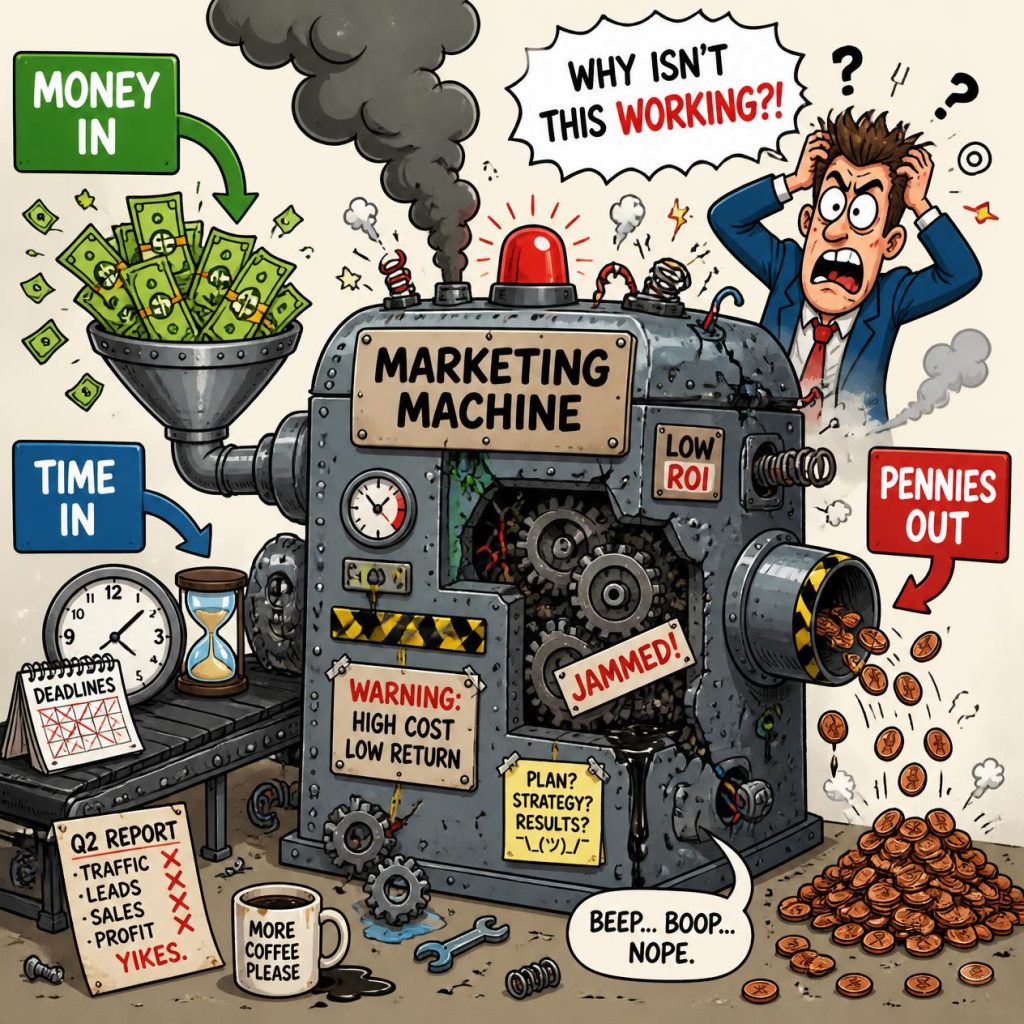
According to several studies online, around 70 – 90% of marketing campaigns fail to produce the results people hope for.
That’s insane (and no wonder Google and Facebook are rich).
By “fail to produce the results people hoped for”, I mean one of the following:
- The business did not produce results and lost money.
- The business barely broke even or hardly produced any meaningful results.
- The business didn’t achieve their goal and generate the results they were expecting.
Now, I’m not entirely sure if the numbers on those stats are realistic and true, but I do know for a fact that there are many business owners out there who are frustrated with their marketing.
And I’m sure that, as a business owner yourself, you’ve probably felt frustrated with your own marketing at some point.
You probably know other business owners who are in the same boat too.
And if you spend a little time digging online, you’ll find a whole lot more who are sinking right along with them.
Business owners who have spent thousands of dollars on websites, ads, SEO, social media, and marketing agencies, only to end up disappointed with the results.
Some barely broke even.
Others lost money.
And many were left wondering:
“Why isn’t my marketing working?”
So…
Why is it that most marketing campaigns produce disappointing results?
There can be a lot of reasons why…
Some that are out of our control like:
- A bad market.
- New competitors entering the market.
- Changes in marketing trends
- Seasonal slowdowns.
- Etc.
But there is something you do have control over:
The way your marketing is built.
The problem is, a lot of businesses skip the foundation and jump straight into tactics.
They run ads.
Build websites.
Post on social media.
Hire agencies.
But underneath it all, the foundation is weak.
And that’s how a lot of time, money, and effort gets wasted.
If you want your marketing to work better, you need to build it the right way from the ground up.
So how do you do that?
That’s exactly what we’re going to cover.
The Fundamentals of Marketing
Look at almost anything complex around you, whether it was built by nature or by people.
Trees.
Buildings.
Boats.
Cars.
Planes.
Even life itself.
All of these things are built on a foundation based on timeless principles that never change.
They can grow, evolve, and become more advanced, but only if the foundation supporting them is strong.
For example, think about a tree.
A tree can only grow as tall as its roots allow.
The same is true for building.
You can’t keep adding more floors if the foundation underneath it can’t handle the weight.
Marketing works the same way.
You can have the best tools, ads, software, and technology available, but if the foundation underneath your marketing is weak, your marketing is still going to struggle.
And this is especially important today because there is always something new coming out.
A new platform.
A new tool.
A new strategy.
A new trend everyone says you need to jump on.
And if you don’t keep up?
You’re told you’re going to get left behind.
Right now, AI is the perfect example.
“If you’re not using AI in your marketing, you’re going to fall behind!”
You’ve probably heard some version of that already.
And don’t get me wrong.
I absolutely think businesses should keep up with new tools and technology that can help them compete and operate better.
For example, right now I encourage businesses to automate as much repetitive work as they can.
But new technology doesn’t replace the fundamentals.
It only helps you do the fundamentals better.
If your marketing foundation is weak, adding more tools and technology isn’t going to magically fix it.
In some cases, you’ll just end up doing the wrong things faster.
That’s why the foundation has to come first.
Because tools, platforms, trends, technology change.
But the fundamentals always stay the same.
The Fundamentals Of Marketing
So, what are the fundamentals of marketing?
It really comes down to one thing:
Understanding how people think and why they buy.
That’s what marketers call buyer psychology or the buying journey.
Every person, including you and me, goes through a similar process whenever we buy something.
It normally looks something like this:
- You realize you have a problem or want something.
- You start looking for a solution.
- You research your options.
- You compare different businesses.
- You decide who you trust the most.
- You think about the price, the risks, and whether it’s worth it.
- Then you make a decision.
It doesn’t matter what you buy.
Whether you’re buying a house, looking for a place to take a vacation, or just buying a new shampoo, the process is still the same.
The only thing that changes is how fast you go through it.
How fast you go through this process depends on how expensive this product/service is and how emotionally invested in it.
If you’re buying a house, that’s a huge purchase with a lot of money and emotion involved. So you might spend months or even years researching and thinking about it.
If you’re planning a vacation, there’s still a good amount of money and emotion involved, but the decision might only take a few days or weeks.’
And if you’re buying something simple like shampoo, it’s usually cheap and doesn’t involve much emotion, so you might go through the entire buying process in just a few minutes.
But check this out.
If someone really cares about their hair, there’s naturally going to be more emotion involved.
Maybe they have dry hair, thinning hair, curls, dandruff, or some other specific thing they’re trying to deal with.
That means the products that actually fit what they need may cost more.
Because there’s more emotion involved and the product costs more, that person is going to spend more time researching.
They’ll compare brands, read more reviews, look at ingredients, and maybe even read blogs or watch videos.
Meanwhile, someone who just needs shampoo might glance at a few bottles, compare the price, skim the label, and toss one in the cart within a few minutes.
The point in this section is, everyone still goes through the same basic buying process.
It happens when choosing a dentist.
Picking a restaurant.
Hiring a roofer.
Buying a car.
Remodeling your home.
Hiring a consultant.
Or even buying something as simple as a can of beans.
What changes is how long it takes.
Usually, the more expensive the purchase and the more emotion involved, the longer the buying journey.
Why a lot of Marketing Fails
One of the biggest mistakes businesses make is trying to skip parts of the buying journey.
A lot of ads, websites, social media posts, and other marketing jump straight to something like:
“Buy now!”
Or…
“Give me your contact information!”
Obviously, they don’t always use those exact words, but that’s basically what they’re asking.
The problem is, the person may not be ready for that yet.
Maybe they’re still researching.
Maybe they’re comparing options.
Maybe they’re trying to figure out if your product or service is worth the risk.
If that’s where they are, asking them to buy or hand over their information too early can push them away.
But the opposite can also happen.
Say someone is already close to buying and clicks on your ad.
At that point, they don’t need a bunch of fluff.
They need to quickly understand what you offer, why they should trust you, and what they need to do next.
If your page makes that hard to figure out, they may get confused, hesitate, and leave.
So the goal is simple:
Meet people where they are in the buying journey and give them what they need to move forward.
If they’re researching, give them helpful information.
If they’re comparing businesses, show them why they should choose you.
If they’re looking for proof, show them reviews, testimonials, case studies, before-and-after photos, stats, or anything else that backs up what you’re saying.
If they’re worried about the risk, answer those concerns directly. Show your guarantee, answer common questions, or show proof from customers who had the same concerns.
And if they’re ready to buy, make the next step obvious and easy.
Give them a clear way to call, book, request a quote, schedule an appointment, or take whatever action you want them to take.
Later in this series, I’ll show you how to build all of this into your marketing strategically.
For now, just remember this:
Good marketing is about giving people the right message at the right time, based on where they are in the buying journey.
Don’t give people the information they’re looking for, or overwhelm them with too much information when they’re ready to buy, and you may lose them.
Observe Yourself
One of the easiest ways to understand your customers is to pay attention to how you buy things.
Think about the last time you bought something.
Maybe it was a bag of rice, dog food, a car, a vacation, or even a home remodeling project.
Those purchases are all very different.
But your brain still goes through a similar process.
You ask questions.
You compare options.
You look for reasons to trust one choice over another.
And you try to avoid making a bad decision.
The biggest difference is usually how much time and thought you put into it.
If you’re buying something cheap, like a bag of rice, you might look at a few brands, skim the label, compare the price, and make a decision in a few seconds.
But if you really care about what you’re buying, you might spend more time on it.
Maybe you care a lot about your health.
Or maybe you’re picky about what your dog eats.
Now you’re probably going to compare more brands, read more labels, and do a little more research.
And when the purchase is expensive and emotional, the buying process gets even longer.
Think about buying a car, planning a wedding, or remodeling your home.
You wouldn’t just jump and call the first business you see online, no matter what they say “buy now” or “enter your contact details to get a free quote!”. (Mistakes a lot of businesses make).
What you will do is search Google, visit different websites, read reviews, watch videos, compare businesses, ask friends and family, or even dig through Reddit and Facebook groups.
And guess what?
Your customers are doing the same thing.
The more you pay attention to how you make buying decisions, the easier it becomes to understand what’s going on inside your customer’s head.
Every Customer Has a Different Buying Journey
Even though people generally go through the same basic buying steps, the journey itself can look very different from person to person.
In other words, not every customer is going to have the same buying journey.
It depends on things like what they’re buying, who they are, what they care about, and the situation they’re in.
For example, think about someone looking for a dentist.
A person with a terrible toothache is probably going to move fast. They want someone nearby who can see them as soon as possible.
But someone thinking about getting veneers may spend weeks researching dentists, comparing before-and-after photos, reading reviews, and looking at prices.
Same type of business.
Completely different buying journey.
In the next post, I’m going to show you how to figure out how many different buying journeys your business has.
This is important because if you want your marketing to work as well as possible, you can’t talk to every customer the exact same way.
Different customers have different problems, questions, concerns, and reasons for buying.
So your marketing needs to speak to each type of customer differently.
Conclusion
Here is what you should take from all this:
Good marketing starts with understanding how people actually buy.
Your customers have questions, concerns, and doubts they need answered before they’re ready to move forward.
Your job is to understand where they are in that journey and give them the right information at the right time.
And remember, not every customer will take the exact same journey.
In the next post, we’ll figure out how many different buying journeys your business has and how to start building your marketing around each one.
By the way…
I help small business owners build a marketing system around your ideal customer buying journey.
If you’d like to know how I can help you build a marketing system that works, check out the following link: